





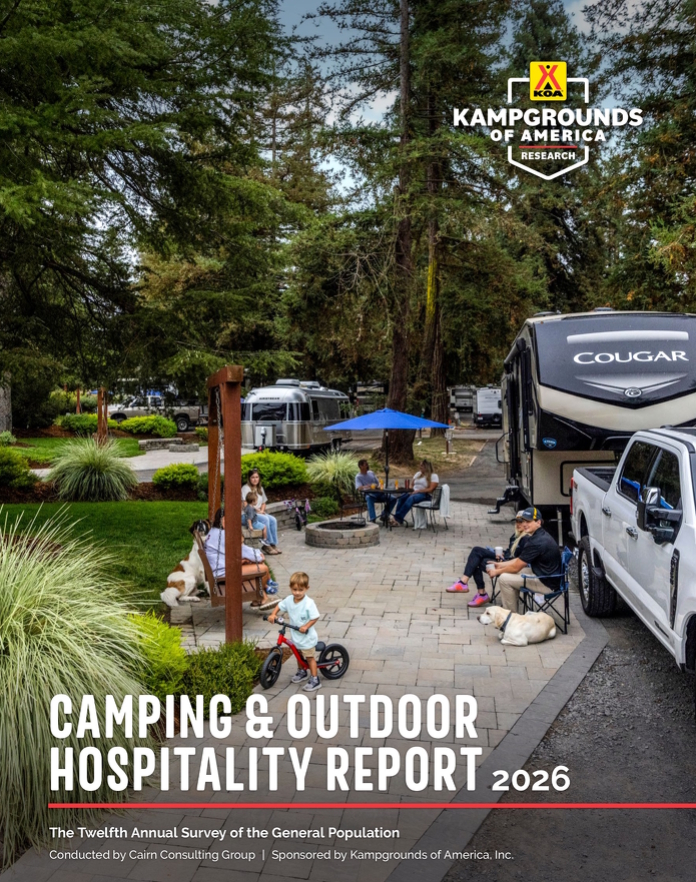
The 12th annual Camping & Outdoor Hospitality Report continues to highlight the stability of the outdoor hospitality industry as it settles after the COVID pandemic.
Conducted by Cairn Consulting Group and sponsored by Kampgrounds of America Inc. (KOA), this year’s report is highlighted by the fact that most of its key data points were closely aligned with the 2025 edition.
Looking at data collected during 2025, the 2026 edition notes that the number of active North American camping households remained nearly at identical levels YOY, sitting at just over 52 million.

“Most of the key data points compared to last year have stabilized and I think that’s really important,” said Toby O’Rourke, CEO and president of KOA, during an interview with Woodall’s Campground Magazine (WCM). “Since we started coming out of the pandemic, we’ve been seeing some shifts, and just this resetting. I think that having these two years now, 2024 and 2025, that are very similar to each other, shows us where that stable baseline is.”
One issue that is highlighted in this year’s report is camping frequency, with numbers indicating that fewer people are camping two to three times a year.
“If you look at just the numbers of people who camped over these past couple of years, you see that it has been pretty stable, but we are still way ahead of what the numbers showed pre-pandemic,” said O’Rourke. “It’s like a 24% increase versus 2019 in people who camped last year. What has changed is the frequency. Since 2019, there’s been a 257% increase in people camping just one time a year.
“I think that that’s really critical when we think about how that relates to campground performance and how we think about RV sales and the usage of the product,” she added. “When I started in this business 15 years ago, we used to talk about people camping four times a year. That was just more ad hoc before we started doing this research. The reality is that a lot more people are just camping once a year and if we’re going to tackle something together as an industry, I think it’s getting more frequency. Getting people to camp at least twice a year would have a huge impact on everybody’s business.”
Another interesting portion of the report focused on the cross-section of generations who enjoy camping, with younger camper numbers, including Millennials and Gen Z, seeing downward swings. Baby Boomers, however, continue to grow.
O’Rourke told WCM that the majority of the swing is probably economy-related.
“We are seeing more price sensitivity and people saying camping’s not affordable for me in the younger generations,” she explained. “I also think that Gen Z is probably choosing other forms of travel. We have to watch that, because that’s the future RV buyer and we want to make sure that we are bringing them into camping. We need to make sure that we are keeping in mind different price points in our campsites to appeal to these more price-sensitive campers. That goes on the RV side, too.
“I do think it is something to be concerned about,” O’Rourke added. “I am, however, very excited about the increase in Baby Boomers. We are really seeing them come out camping again, and what has surprised me the most is that there are a large number of new campers in that segment, too, and that generation is less price sensitive.”
Other Key Report Data Points
Outdoor Hospitality is an Economic Powerhouse: Spending momentum continues to accelerate, driven by younger generations and families with children. Average daily expenditures per person, excluding accommodations, reached over $200 in 2025, reflecting both consumer engagement and willingness to invest in outdoor experiences. This growth comes as camping has solidified its position as an approachable travel option. Overall, 35% of U.S. adults cite camping as the easiest form of travel with children and 35% state camping is the most affordable travel option.
This expanded, engaged base contributed to the outdoor hospitality sector’s economic footprint, reaching $66 billion in local community spending, over a $5 billion increase from 2024.
Glampers Are Converting to RVs: The report notes that half of all Millennial glampers are interested in RV rentals, with 33% of Gen Z glampers considering the purchase of an RV.
“I think we are starting to see that glamping is becoming a good gateway, which is what we have always believed at KOA,” noted O’Rourke.
New Campers Like Lodging Units: 29% of campers stayed in a cabin or other form of glamping unit.
“A lot of new campers are coming in through the accommodation side,” said O’Rourke. “There is a lot of demand for these types of units and they are definitely driving interest.”
People are Bringing Furry Family Members: 62% of Millennials always or sometimes camp with their pets; 60% of Gen Z pet campers say that getting their pet off-leash is essential while camping.
“I think that’s why a lot of people choose to camp, because they can bring their pet along,” O’Rourke said. “You can’t bring your pet to a lot of different places where you might be traveling.”
People are Borrowing RVs in Larger Numbers: Separate from renting, 21% of travelers borrowed an RV in 2025.
“I think that is probably tied to the economy, too,” explained O’Rourke. “It probably gets to the fact that people aren’t using their RVs as much and they are more inclined to let a friend borrow it.”
Cause for Concern in the RV Industry: “We have been seeing a decline in the RV numbers over the past few years, with this report showing RVing is down 14% in the number of households that RV’d versus 2019,” O’Rourke explained. “That is almost one-and-a-half million campers. I think we are stabilizing, so that is good, and hopefully we are not going to bleed anymore, but we have got to start building back.
“I think it is obvious that we are going to be down from 2021 when everyone was trying RVing, but to be down from 2019 is concerning to me,” she added.
New Campers are Still Coming: The report notes that there were still over two million households that camped for the first time last year and about eight-and-a-half million over the past couple of years.
“I think that that’s really affirming to the marketing that’s going on, and the word of mouth and experience that people are enjoying,” O’Rourke explained. “In the report, we also noted the high percentage of people who had a great first experience.”
Unstructured Play & Wellness Are Key: Perhaps the most compelling finding is the shift in why people camp. Wellness has emerged as a primary driver, with 77% of campers stating that “just being in nature is enough” without structured programming or additional amenities. This analog approach to camping by prioritizing simplicity and natural restoration over curated experiences reflects a meaningful generational shift.
Nearly half of all campers (49%) intentionally book trips to improve mental well-being, and 50% prioritize experiences that help them recharge. This orientation around unstructured outdoor wellness represents a meaningful recalibration for outdoor hospitality’s value proposition. Campers are no longer seeking entertainment; they’re seeking restoration. Mental well-being ranks as the top wellness motivator across all generations, with outdoor activities like walking near water, wildlife viewing, and night sky viewing leading engagement.
“I think that is a benefit of camping, you don’t have to have this over-scheduled vacation and you don’t have to have a packed itinerary,” noted O’Rourke. “It really is about relaxing and seeing what opportunities arise in the day and how you’re going to spend your time.
“We’re really pushing and aligning with the idea that camping is part of mental health and being outdoors,” she continued.
2026 as a Year of Intentional Outdoor Experiences: Campers are planning more ambitious travel in 2026, with 31% planning to spend more nights under the stars compared to 2025. Road trips, small-town exploration, and heritage travel are driving extended camping journeys, while major cultural events, including the Route 66 Centennial and America 250 celebrations, position outdoor hospitality as both nostalgic and forward-looking.